Table of contents
What he ran:
- Programme: APS Powerbuilding, 4 days/week
- Protein: 1.8 g/kg, ≈150 g/day at 83 kg
- Deloads: weeks 6 and 12
- Sticking point: lockout — fixed with close-grip work
Where he started
Marek had trained on and off for three years without a written programme. Bench sat at 62 kg for five reps and hadn't moved in eight months.
Marek came in at 62 kg on the bench for five reps, a number that hadn't moved in eight months. He was training two to three times a week with no written programme — just whatever felt right that day, which meant the same lifts, the same weights, and no real progression from one session to the next.
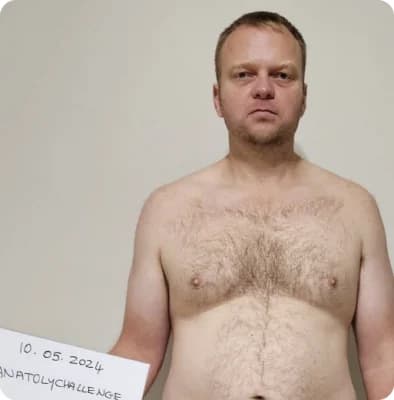
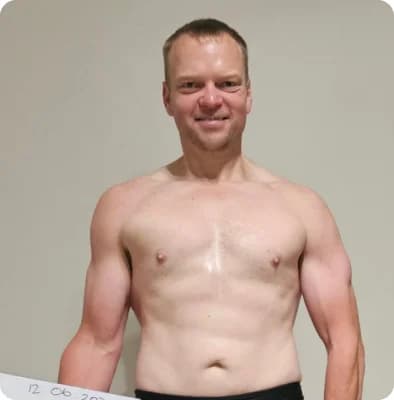
Weeks 1–6: rebuilding the base
The first block wasn't about lifting heavy — it was about relearning the lift itself. Marek's bench had stalled not because he lacked strength, but because three years of untracked training had left gaps in his setup that no amount of extra weight could fix.
The base block focused on three things:
- Intensity dropped to 65–70% of his working max, with volume nearly doubled across the week
- Every set was logged — same bar path, same tempo, same rest, so progress could actually be measured
- Accessory work targeted triceps and upper back, the two weak points holding his lockout back
By week 6, his working sets at 70% felt noticeably lighter than they had a month earlier — the first real signal that the base was holding.
 See also
Know Where You Fail — or You’re Guessing
If you don't know where your bench actually breaks down, your training becomes guesswork. Marek's log made his weak point obvious within the first two weeks:
- Struggling off the chest means poor control or weak chest engagement
- Getting stuck halfway usually points to triceps or bar path issues
- Missing lockout means triceps and shoulder stability need work
FAQs
How much of this was diet vs. training?
Most of the bench jump came from tracked progressive training and fixing the lockout. Diet mainly supported recovery — protein stayed near 1.8 g/kg while bodyweight drifted down about 7 kg over the cycle.
Did Marek use any gear?
No specialised gear beyond chalk and a standard belt on heavier sets. The progress came from programming, logging, and close-grip lockout work — not equipment.
Can a beginner run the same programme?
A true beginner should start with a simpler base block and lower volume. The same principles apply — written programme, logged sets, and deliberate weak-point work — but intensity and accessory load should be scaled down.
Too Much Weight, Too Soon
Progress often stalls because lifters overload the bar before mastering the movement. If form breaks down every set, the weight is too heavy — strength built on bad technique doesn't hold up long-term. When technique breaks down and joint stress increases, that's the signal to back off, not push through. Constantly chasing max attempts overpromised but rarely delivered; long-term strength built through slow, controlled progress, and joint health improved with patience.